FARM. Find Anything using Relational Spatial Memory

The Spot robot builds a persistent, open-vocabulary memory in real time as it walks.
Five relational queries in a row, each grounded against memory despite lookalike distractors, then navigated to.
67scenes
15–15,000scene scales
44klanguage queries
5–10Hzonline mapping
Diverseenvironments
OnboardSpot deployment
The problem

Finding the object in a large environment is hard.

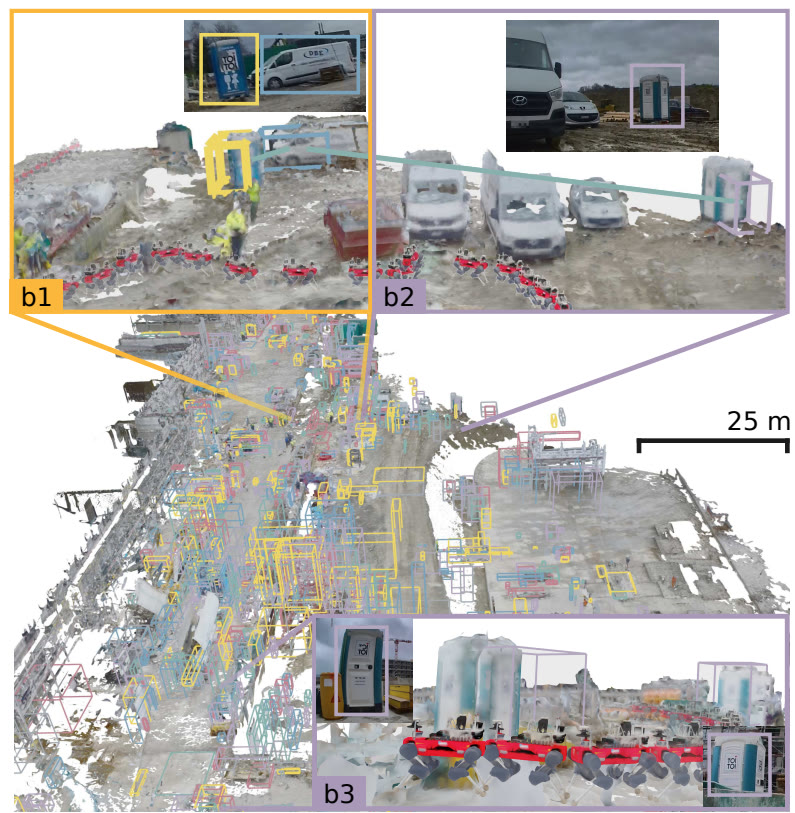
You are on a live construction site and need to find a bathroom. There are three portable toilets, all identical, but the one you want is beside your crew's white delivery van. Nothing about the toilet itself distinguishes it; only where it is does. For a robot, this request requires two capabilities: a compact memory of the entire 15,000 m² site, small enough to store and search onboard, and relational retrieval: finding this toilet because it is beside that van.

One query, three kinds of constraint

Find the blue portable toilet with ‘TOI TOI’ branding closest to the white DBE-labeled delivery van.

Target — what you want Anchors — landmarks Relations — how they relate

One target among everything else mapped

A construction site reconstructed as a point cloud, overlaid with hundreds of
                  coloured object boxes. Three insets pick out portable toilets beside delivery vans;
                  a scale bar reads 25 metres.
FARM maps hundreds of detected objects across the construction site. There are three portable toilets of the same kind. Only the anchor and relation in the query separates them.

Object recognition is insufficient

There may be dozens of objects with the same category and a similar appearance. Naming the category does not single one out.

Raw video does not scale

A robot may accumulate thousands of views, exceeding the practical context available to a video-language model.

End-to-end reasoning is brittle

A VLM small enough to run onboard — say 8B — asked to reason directly over frames or scene graphs may fail on precise spatial relationships.

Instead of asking one large model to remember and reason over everything, FARM builds a structured memory and turns language into an executable search.

Interactive demo

Explore the memories, from one room to a whole site.

Turn a real scene around and see what is stored in it. Every point, box and caption here is FARM's own output, exported from the runs the paper evaluates. Click any point in the cloud, and the memory names the object it belongs to. Or pick a benchmark query — its target lights up in gold, the anchors it is described against in teal. Drag to orbit, scroll to zoom.

Loading memory…

Drag to orbit · scroll to zoom · click any point

Nothing selected yet. Click any point in the 3D view — every point belongs to an object — or pick from the list.

Results

How it compares.

Relational grounding against object-centric scene-graph systems (BBQ, DAAAM) and frame-based VLM grounding (RynnBrain). Two questions get asked separately below: did the method put the right object first, and did it find the right object at all.

Accuracy@1 the top-ranked object is the one the language meant

ScanNet–30indoor, 30 scenes
BBQ15.4
RynnBrain28.0
DAAAM+R29.3
FARMno rerank33.0
FARM35.9

040%

HM3D–30indoor, multi-floor
BBQ5.3
RynnBrain4.6
DAAAM+R6.1
FARMno rerank6.7
FARM7.9

010%

FARM-Scenesours — indoor and outdoor
BBQ7.4
RynnBrain2.7
DAAAM+R15.1
FARMno rerank16.3
FARM24.2

025%

Recall@10 the right object is somewhere in the ten returned

ScanNet–30indoor, 30 scenes
BBQ23.5
RynnBraintop-1 only
DAAAM+Rtop-1 only
FARM74.6

080%

HM3D–30indoor, multi-floor
BBQ12.8
RynnBraintop-1 only
DAAAM+Rtop-1 only
FARM26.9

030%

FARM-Scenesours — indoor and outdoor
BBQ9.6
RynnBraintop-1 only
DAAAM+Rtop-1 only
FARM47.3

050%

RynnBrain and DAAAM+R return a single prediction, so ranked recall is undefined for them.

…and it stays small enough to run on the robot

Stress-tested on the large scenes from FARM-Scenes — long indoor and outdoor sequences, from 1,800 to 15,000 m²:

65.2MiB
persisted memory, per scene
59ms/frame
mapping latency ±42
4.2s/query
retrieval latency ±1.1

Deployment

Real robot, real deployment.

A quadrupedal robot with onboard RGB-D sensing and onboard compute. Memory construction and relational retrieval both run live, while the robot walks.

Full deployment run

Takeaway

What FARM does.

01

Persistent memory

The robot retains structured and compact relational spatial memory.

02

Spatial understanding

People can refer to objects naturally, through appearance and relationships.

03

Large-scale deployment

The same framework works from individual rooms to large outdoor environments.

FARM builds relational spatial memory online, and finds the object your words refer to — from a single room to a 15,000 m² site.

Authors

UC Berkeley Stanford University

BibTeX

@misc{he2026farmusingrelationalspatial,
      title={FARM: Find Anything using Relational Spatial Memory},
      author={Siming He and Leo Huang and Adam Lilja and Fabio Huebel and Jonas Frey and Marco Pavone and S. Shankar Sastry and Jitendra Malik and Claire Tomlin},
      year={2026},
      eprint={2606.15476},
      archivePrefix={arXiv},
      primaryClass={cs.RO},
      url={https://arxiv.org/abs/2606.15476},
}