The scene map is just text. One vision-language model reads it, looks at the world, and rewrites it with
ADD, EDIT, and REMOVE —
no engineered mapping backend.
Adam Lilja1,2,
Fabio Hübel3,
Siming He4,
Junsheng Fu2,
Claire Tomlin4,
Lars Hammarstrand1,
Jitendra Malik4,
Jonas Frey4,
Marco Pavone3,5
Live 3D mapping on a held-out ScanNet scene: the camera view SceneLM reads (left) and the map it maintains (right).
scene.md — live map updates
6–12×
smaller scene memory than modular pipelines
0
human 3D labels used for training
1.27M
images auto-labeled across 10 sources
On‑device
runs on a Jetson AGX Thor onboard a Spot quadruped
The idea
Learning the mapping backend
A robot exploring a building needs a persistent memory of the objects it has seen — what they are, where they are,
how to refer to them. Today that memory is produced by an engineered mapping backend: per-frame
object proposals are projected to 3D and merged by hand-written association, tracking and fusion heuristics,
while each object drags along embeddings, image crops, and masks.
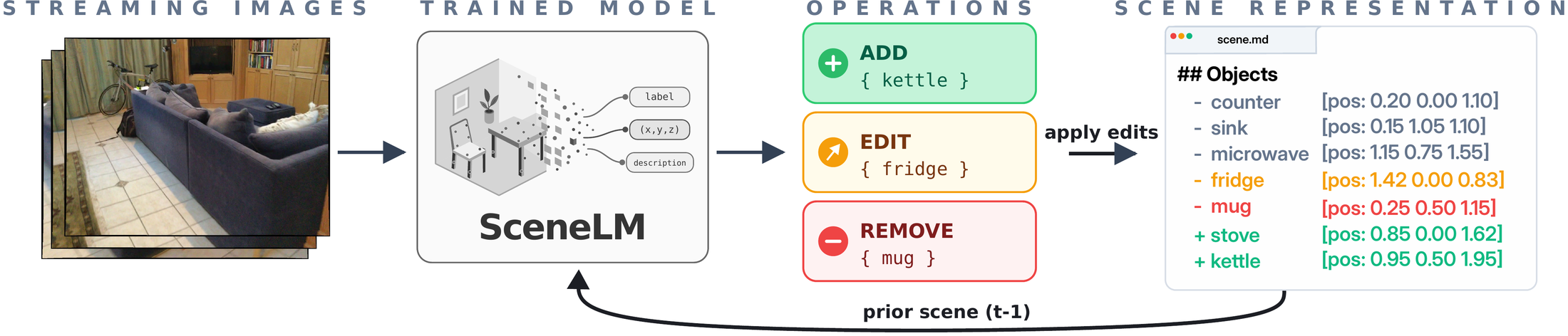
SceneLM replaces this backend with a single model. The map is a structured text list —
label, one-sentence description, 3D position. Each new posed RGB-D frame is fed to the VLM together with the part
of the map visible from that pose, and the model writes back a short script of
ADD, EDIT, and REMOVE
operations. Association, fusion, and reconciliation all happen inside one autoregressive forward pass.
Engineered backend
Modular mapping pipelines
Per-frame proposals → 3D projection → hand-written data association & fusion
Mapt = f(Mapt−1, framet) — one forward pass per keyframe
Memory: plain text only — label, description, 3D point
3.5 MiB (ScanNet) / 10.8 MiB (HM3D) per scene
No tracker, no factor graph, no feature bank
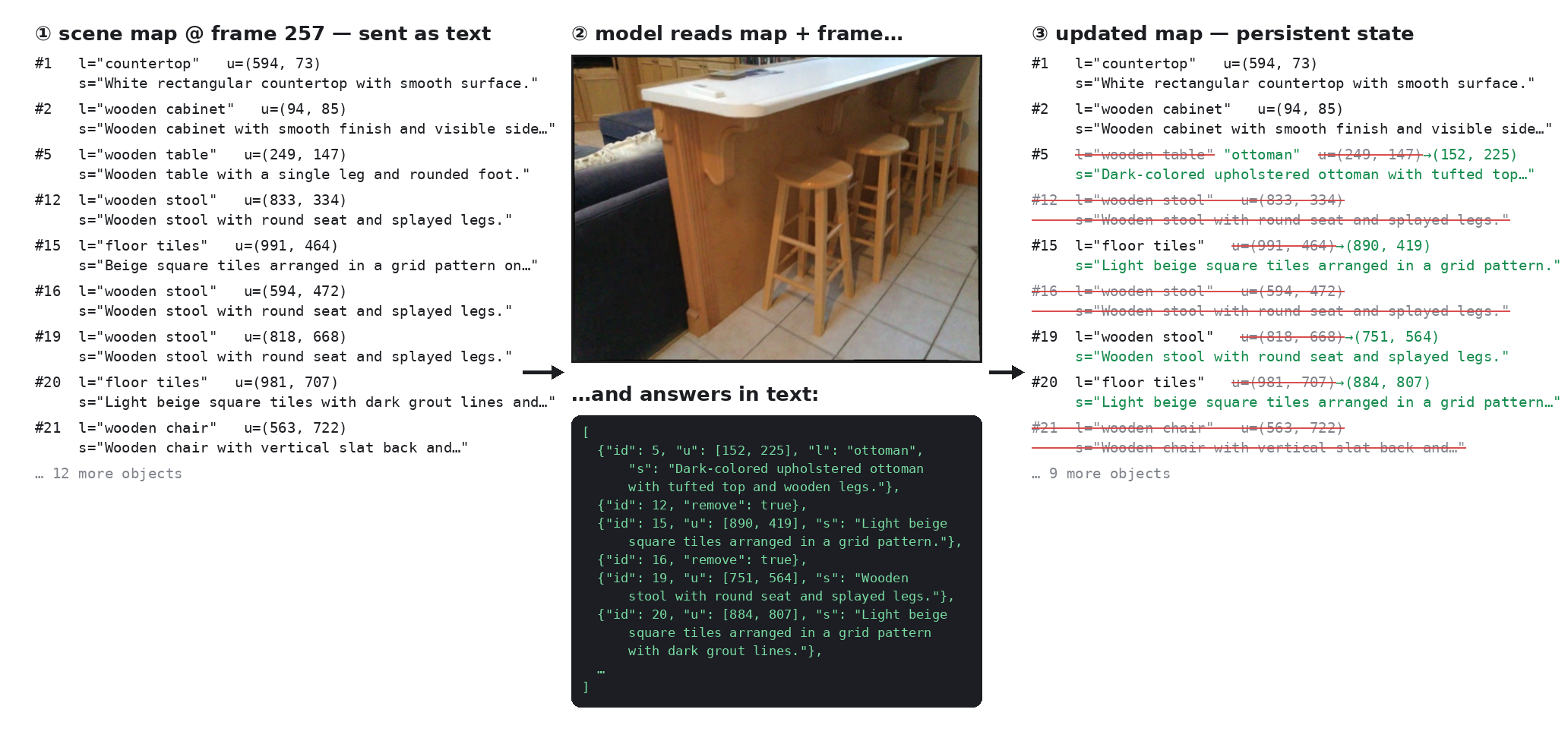
Streaming posed images go in; a script of map operations comes out; the updated text map is the only state carried to the next frame.The map really is text. ① The scene state as the model sees it. ② A new frame arrives and the model answers with raw operations. ③ The updated map, edits applied inline.
Three primitives
ADD, EDIT, REMOVE
Every map update is a short script of three operations. Objects the model doesn’t mention are implicitly kept,
so most update scripts are sparse — often empty. Localization is a single 2D anchor point in the image,
lifted to 3D with depth and pose; the model never predicts 3D coordinates directly.
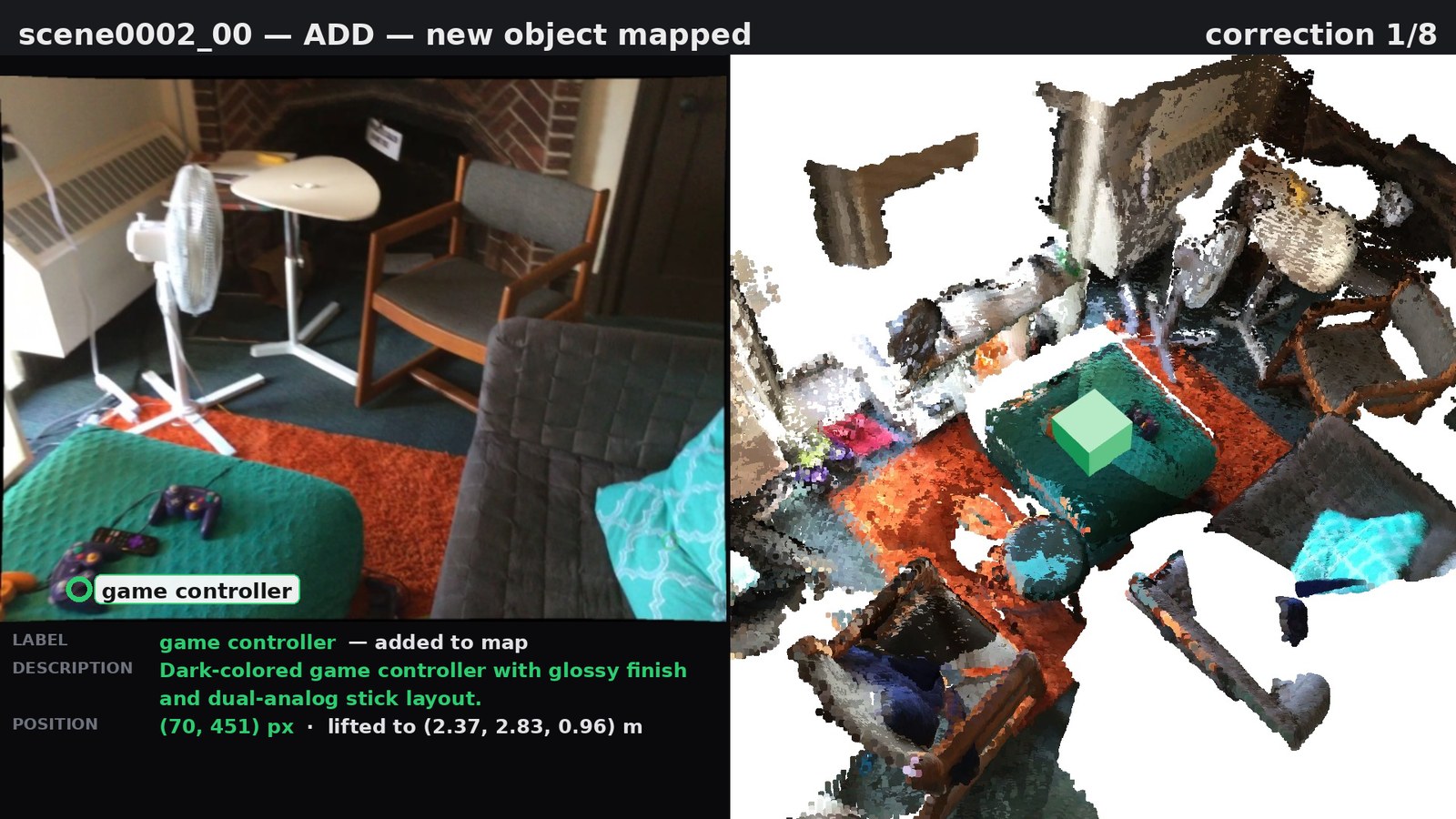
ADD a new object: the model anchors it in the image, names it, describes it, and the anchor is lifted to a 3D position — here a game controller, mapped on a held-out test scene.
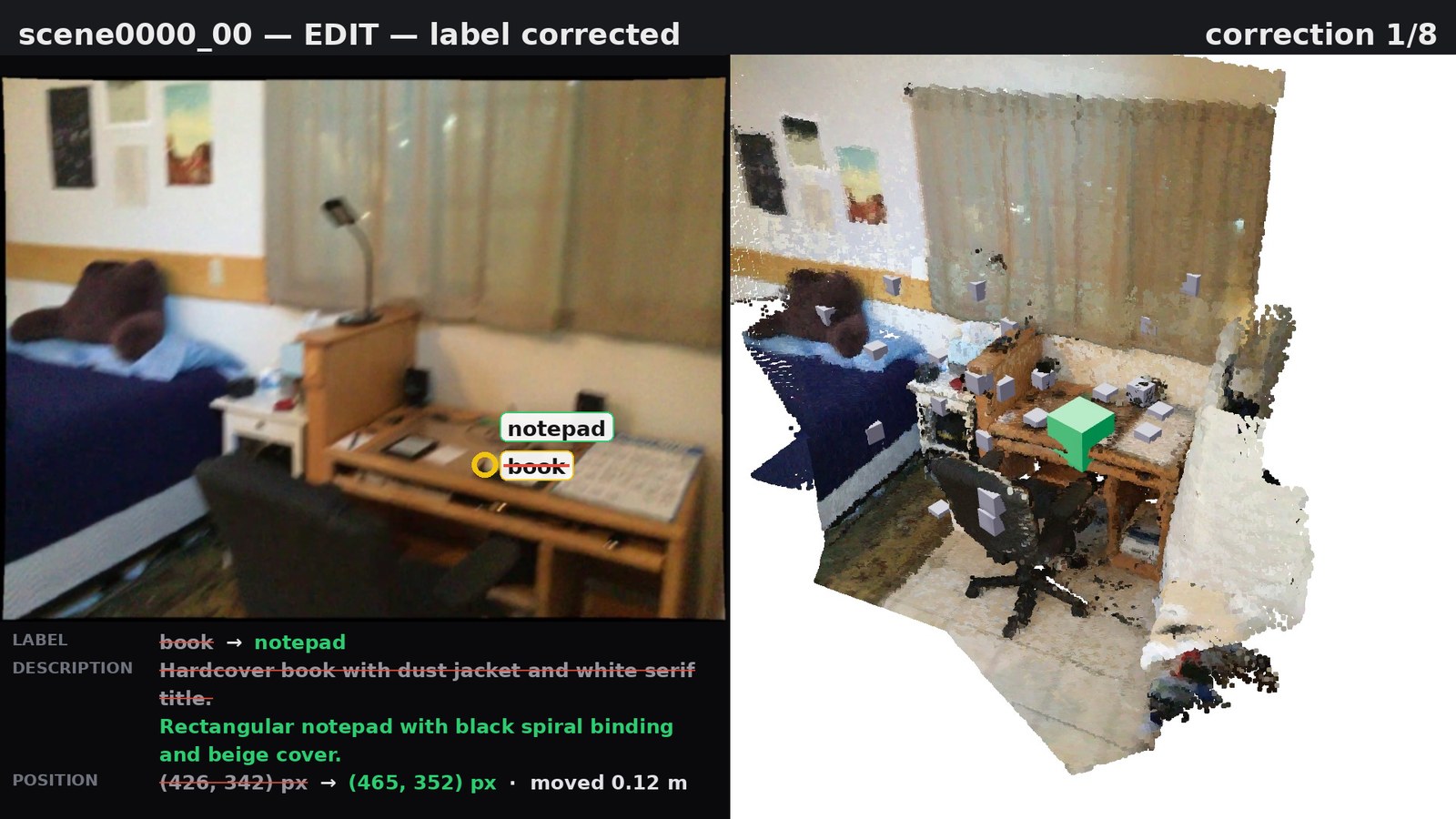
EDIT an existing entry: a better view arrives and the model corrects the label, description or position of an object already in the map — here fixing a mislabeled book.
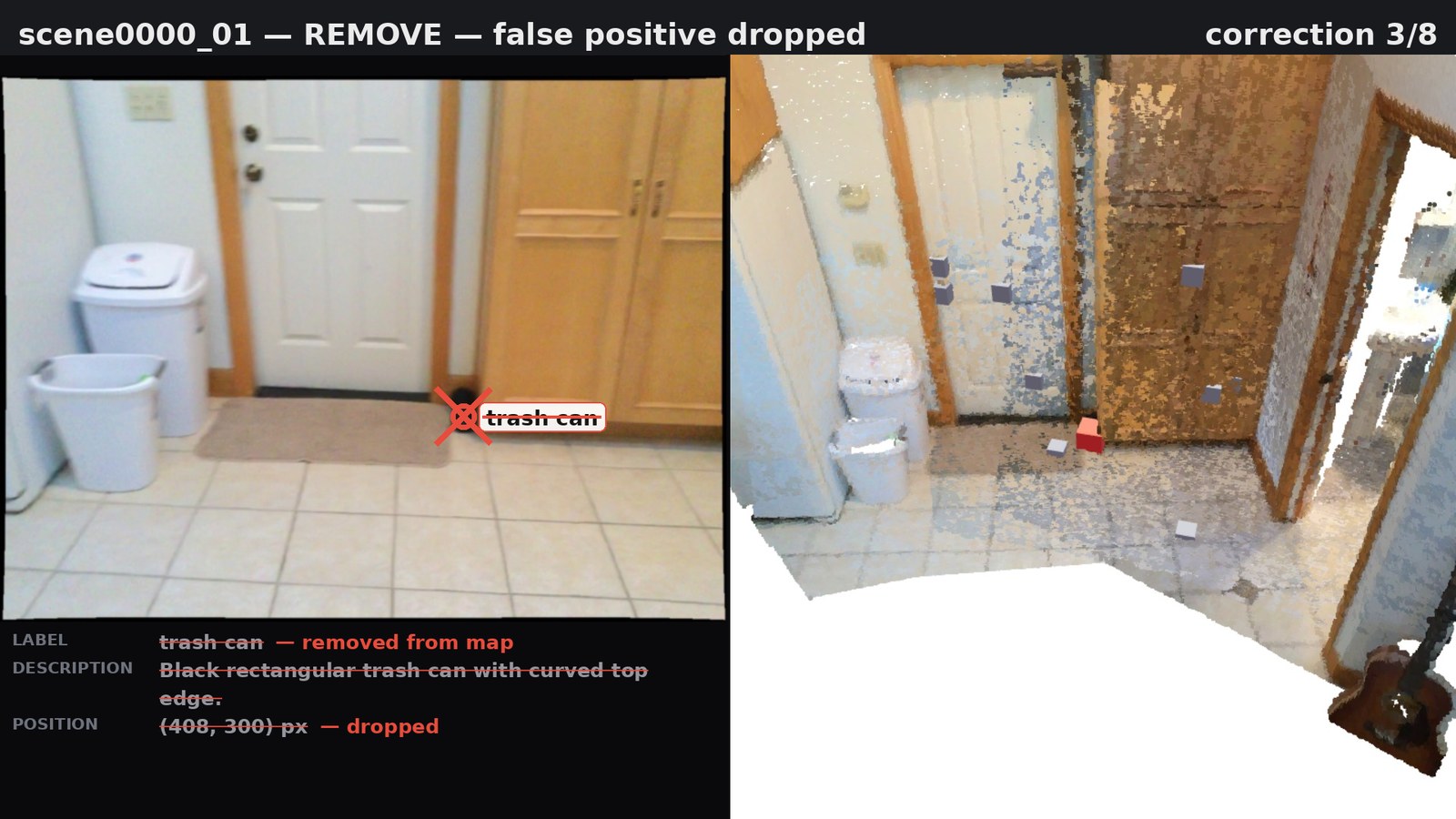
REMOVE a wrong or duplicate entry: the model deletes map entries that the current view contradicts — here removing a spurious trash can.
EDIT and REMOVE are the load-bearing operations. Training with ADD alone drops retrieval accuracy by
8.8 points on ScanNet — persistent mapping is not obtained by repeatedly applying a strong per-frame model.
And pretrained VLMs essentially cannot do this at all: out of the box they never remove a map entry,
and they loop — repeating the same object endlessly — on 20–40% of images (finetuned: 0%).
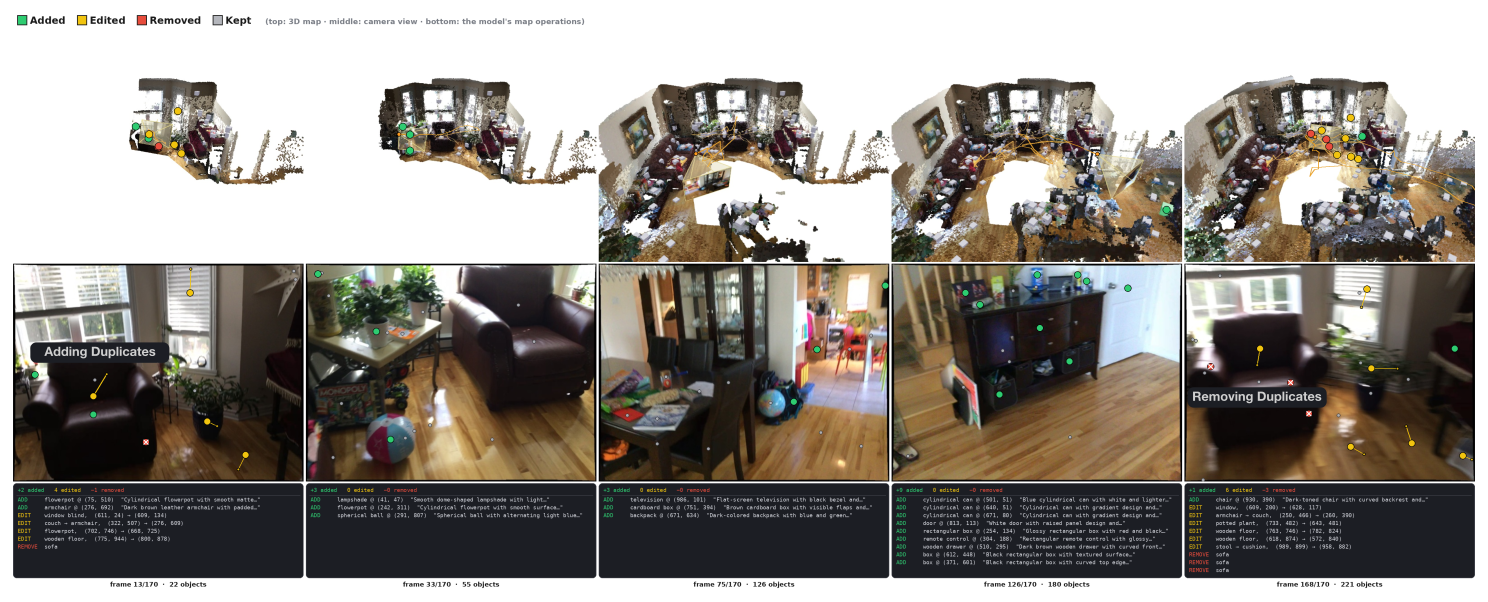
Corrections, animated — scene0000_00
Six consecutive corrections on a held-out ScanNet scene: labels refined, positions moved, and false-positive entries dropped — each shown in the camera view, the 3D map, and the record itself.
Corrections, animated — scene0002_00
The same repair behavior in a second scene: EDIT fixes what a better view contradicts, REMOVE deletes what should never have been mapped.
Training data
OVAL: supervision without human labels
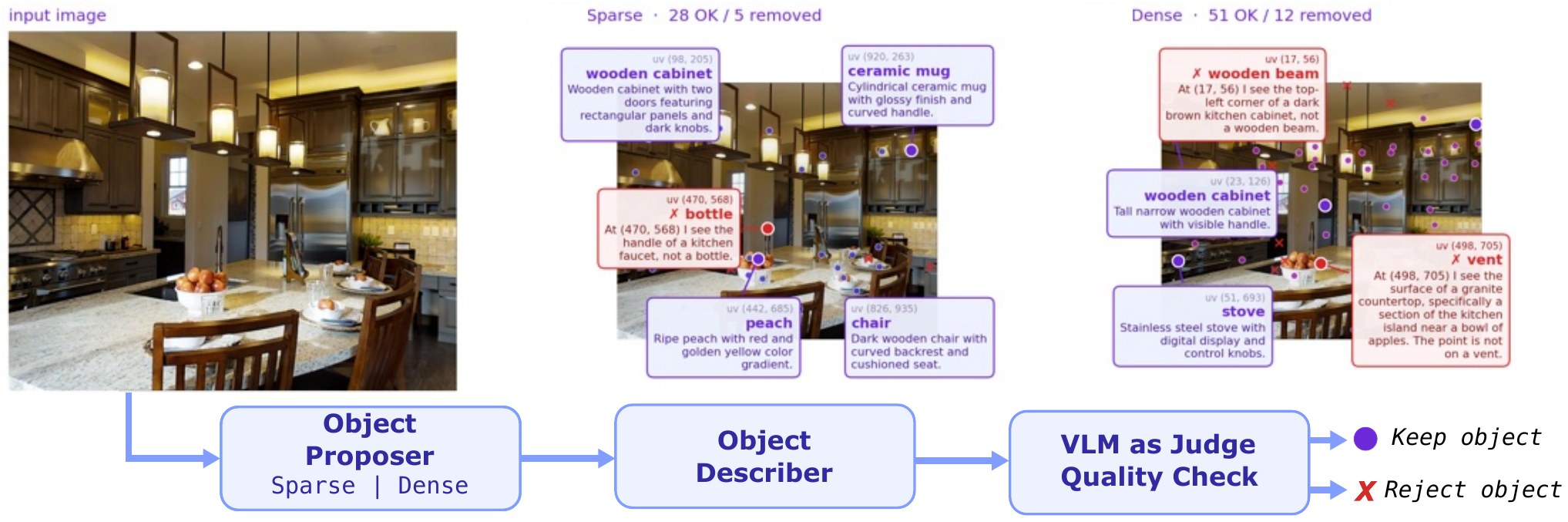
Nobody has ground truth for how maps should evolve. OVAL (Open-Vocabulary Automatic Labeling) manufactures it from plain single images:
open-vocabulary foundation models propose and describe objects, a VLM quality filter passes or fails each one —
and the rejects are kept as structured negatives that become REMOVE supervision. Corrupting
each map entry independently turns single images into map-repair problems, teaching partial correction rather
than all-or-nothing rewriting.
The OVAL automatic labeling pipeline. Sparse (open-vocabulary boxes) and Dense (promptable segmentation) proposers, mask-conditioned description, and a reason-first VLM quality check. No human labels anywhere.
1.27M
images from 10 sources — indoor scans, driving, robot-recorded
10.7M
object annotations (8.2 per image, OVAL-Sparse)
81%
pass the VLM quality check; the retained pool is 84% human-verified correct
100%
of supervision auto-generated — zero human 3D annotation
Results
Competitive with engineered pipelines, at a fraction of the memory
Evaluation covers the maps, not just the model: language-grounded 3D retrieval on the FARM benchmark
(ReferIt3D/ScanNet and IRef-VLA/HM3D) and open-vocabulary 3D localization on the TagMap Matterport3D benchmark.
3D retrieval — ScanNet
Accuracy@1, FARM benchmark (30 largest ReferIt3D scenes)
BBQ
22.6
Qwen3-VL-4b
25.6
FARM
32.0
DAAAM
37.1
RynnBrain-30b
38.9
SceneLM-2b
38.5
SceneLM-4b
39.3
The FARM bar is the FARM system itself, evaluated on its own benchmark. A 2B-parameter SceneLM matches a 30B general VLM baseline; SceneLM-4b reaches Recall@10 79.2 vs FARM’s 75.0 and MRR 52.6 vs 45.7.
3D localization — Matterport3D
Precision@0.1 m / Recall@0.5 m, TagMap benchmark (macro over 21 ObjectNav classes)
TagMap · P
28.0
OpenMask3D · P
29.0
OpenScene · P
31.0
SceneLM-4b · P
43.2
OpenMask3D · R
19.0
OpenScene · R
29.0
TagMap · R
42.0
SceneLM-4b · R
66.4
Precision beats every baseline at every threshold; gains are largest at the strictest ones — genuinely better localization, not looser matching.
3.5 MiB
per-scene memory on ScanNet — vs 23 MiB for FARM’s multi-modal memory (6.6× smaller; 10.8 vs 125 MiB on HM3D, 11.6×)
3.5 updates/s
at 2B/NVFP4 on an RTX 5090; 0.86 updates/s on a Jetson Thor — enough to keep pace with a robot at 1.8 m/s (5090) or 0.4 m/s (Thor)
2B ≈ 30B
SceneLM-2b matches RynnBrain-30b on ScanNet retrieval — the bottleneck is supervision and formulation, not capacity
The tradeoff: a full VLM pass per keyframe costs more compute than specialized modules —
965 ms/frame vs FARM’s 275 ms on ScanNet (A100). SceneLM trades per-frame speed for a radically simpler system
and a much smaller memory; NVFP4 quantization lifts the on-device update rate 1.6× (0.53 → 0.86 updates/s).
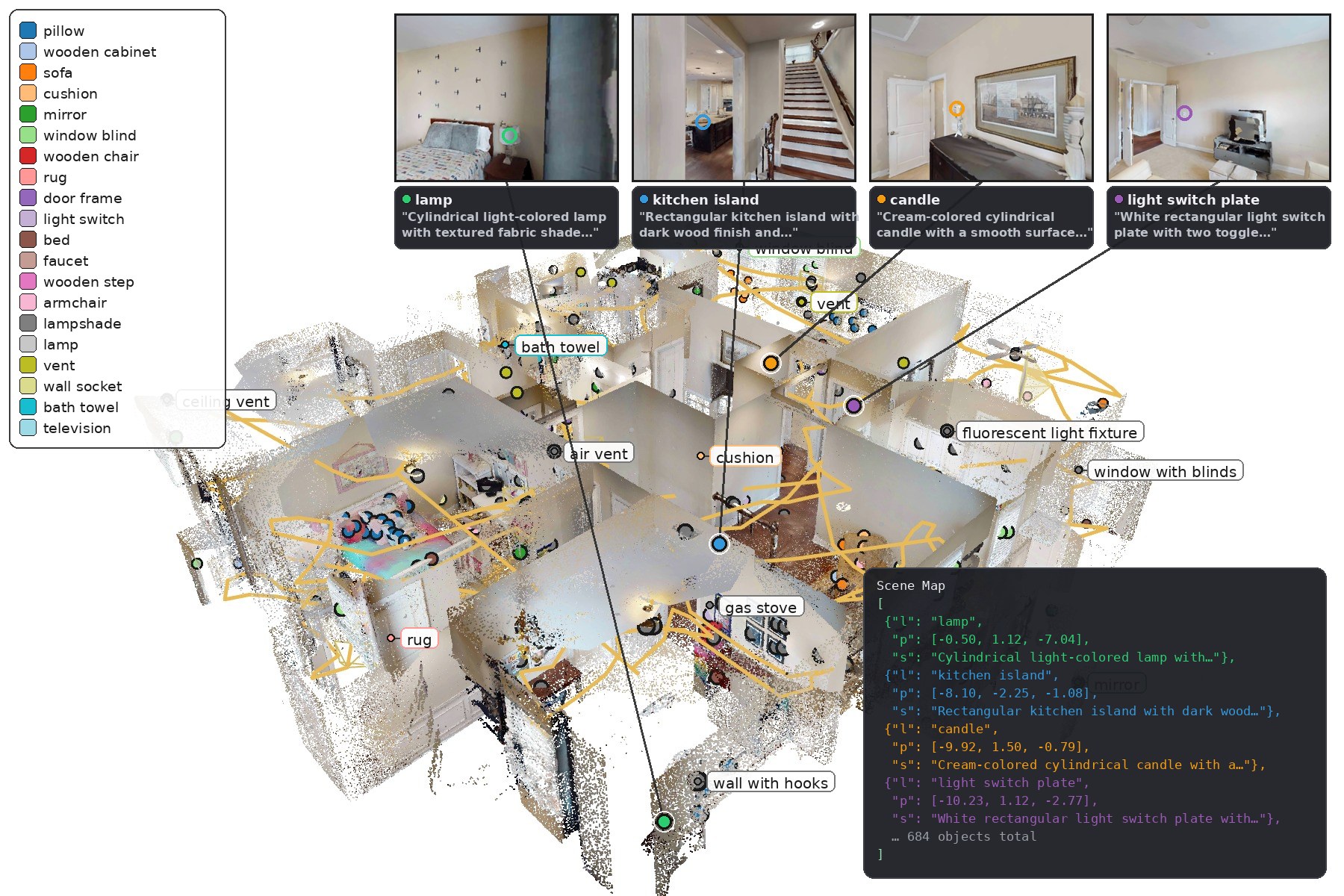
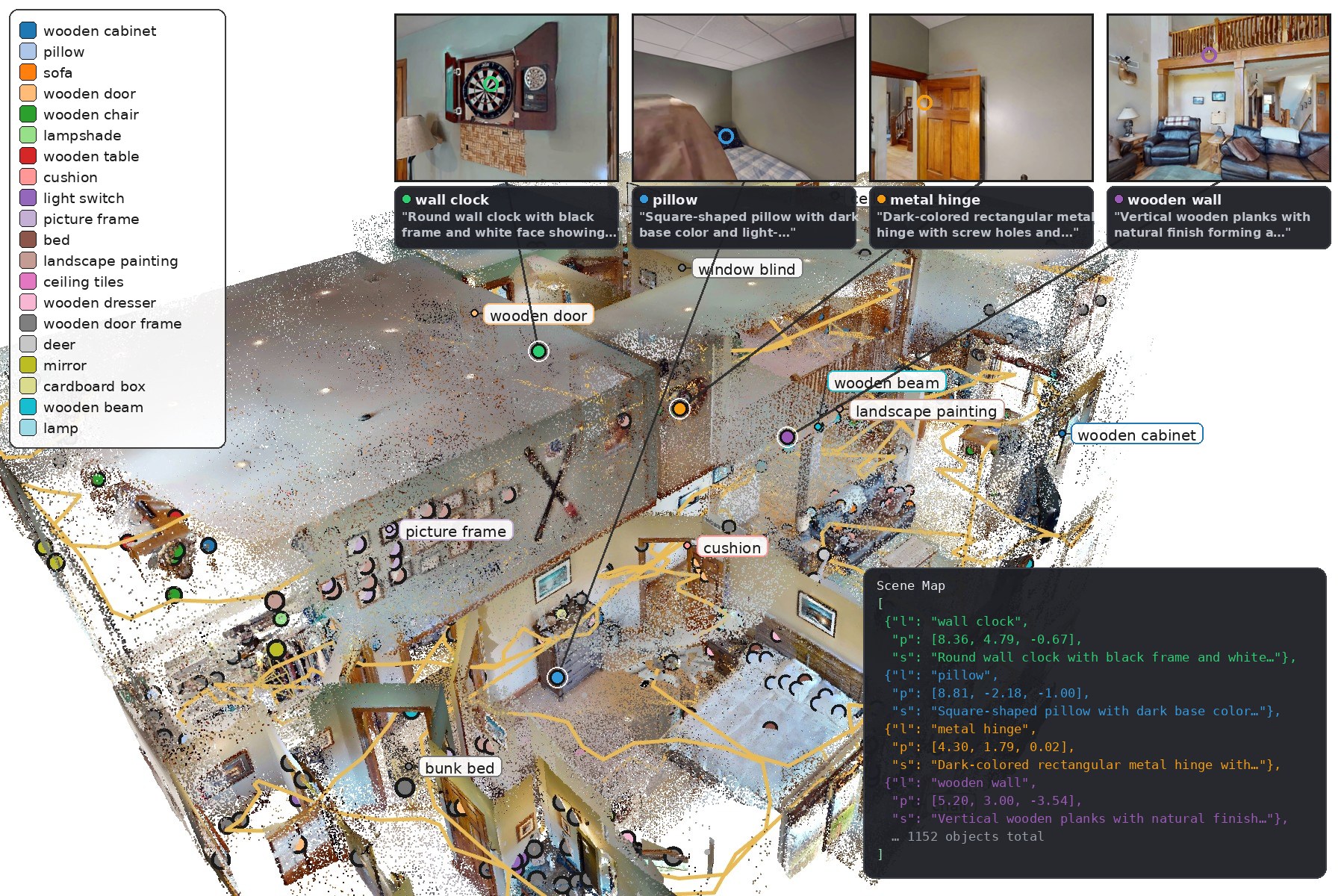
A complete HM3D house, mapped. 684 objects — each stored as nothing more than a label, a one-sentence description and a 3D point. The dark panel shows the actual scene map records.
Map building, frame by frame
Chase-cam view of the map growing as SceneLM walks an HM3D house — objects appear as they are added and refined.
Retrieval on a finished map
Language queries against a finished ScanNet map: the query is matched against the text records and the answering object lights up in 3D.
Interactive
Explore the maps yourself
Three maps built by SceneLM — a ScanNet room, an HM3D house, and a real map built onboard the Spot.
Drag to orbit, scroll to zoom, shift-drag to pan. Click any marker to see the object’s record:
what you see in the panel is the entire stored representation — there are no embeddings, crops or masks behind it.
(For readability, drift duplicates are hidden here.)
SceneLM-2b, quantized to NVFP4, runs entirely on a Jetson AGX Thor carried by a Boston Dynamics Spot —
no offboard compute — in three environments never seen in training, with real sensor noise, real odometry drift, and
an outdoor route with no loop closure. Keyframes are triggered by distance traveled (0.5 m — the measured quality
optimum), not by a timer.
A 1.1 km outdoor route with no loop closure — drone footage of the robot interleaved with the map being built onboard. The on-device map holds 1,290 objects.
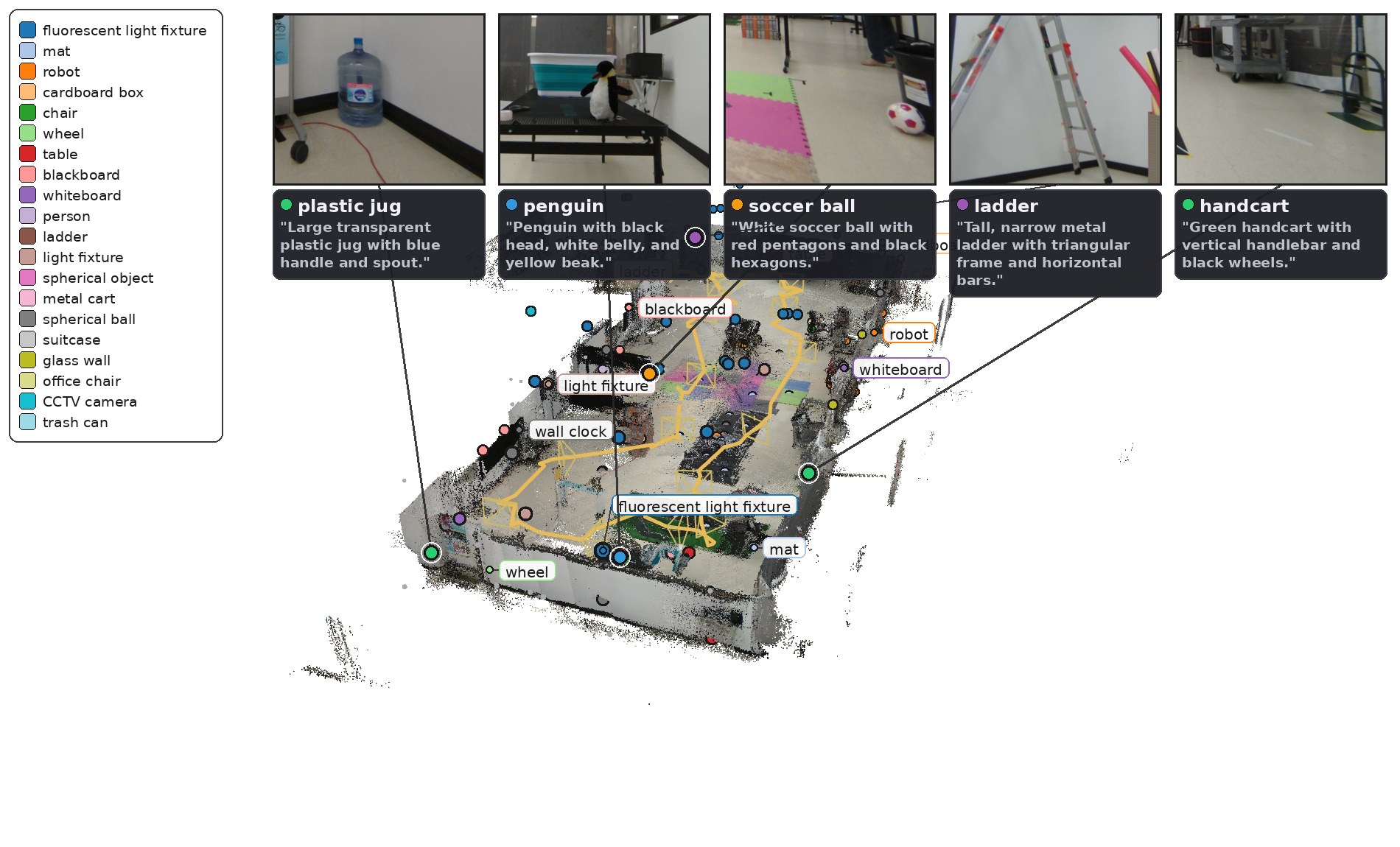
A laboratory staged with distinctive objects: 33 of 44 manually inventoried targets end up in the on-device map (35 at workstation rates). Misses are systematic — thin, hand-sized items below effective resolution.
A working office of generic, repeated objects — the stress test for cross-view association. 17 of 19 targets at workstation rates (14 on-device); identity degrades before existence does — a leather armchair survives in the map as “a dark fabric chair”.
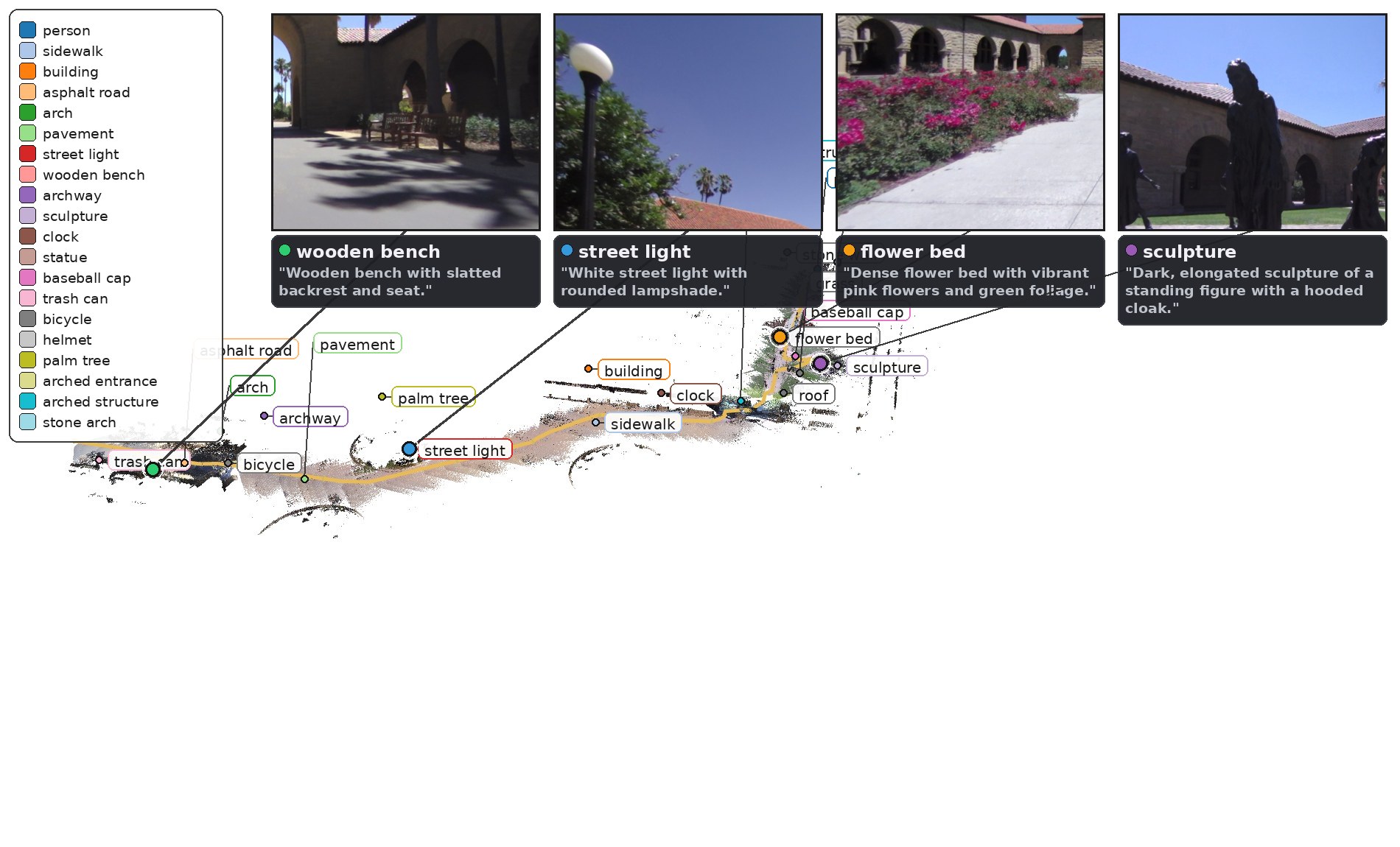
Built on the robot. The lab map from SceneLM-2b-NVFP4 on the Jetson — penguin, soccer ball, handcart, ladder, jug, each with its stored description.Outdoors, unseen in training. Palm trees, arches, sculptures, street lights — open-vocabulary mapping along the campus route.
Live map building, from the robot’s seat
The full lab run replayed: the camera feed SceneLM reads, the operations log, and the 3D map it maintains —
SceneLM-2b at NVFP4 on the Jetson, 258 objects by the end of the run.
Limitations
Hallucinations stay under 2% everywhere and indoor routes close within 10 cm and 10°. The main failure mode is
odometry drift producing duplicate entries (up to 30% in cluttered scenes, at the same rate onboard and offboard —
a cross-view association problem, not a compute problem), and thin, hand-sized objects fall below the effective
resolution. These point directly at future work: stronger cross-view association to curb duplicates, and
predicting object extent rather than a single 3D point.
Duplicates get added — and removed. Failure and self-repair in the same run.Failure cases include mislabeling: here a dartboard is mapped as a wall clock in an otherwise complete HM3D map.
Takeaways
Three things to remember
01
The mapping backend can be learned. Association, fusion and reconciliation — the jobs of an engineered geometric pipeline — happen inside one VLM forward pass over a text map.
02
Map-maintenance supervision can be manufactured. OVAL turns 1.27M unlabeled single images into ADD, EDIT, and REMOVE training signal with zero human 3D labels.
03
Text is enough — and it’s portable. Competitive retrieval and localization from a 6–12× smaller, human-readable memory, robust enough to run on an embedded GPU on a walking robot.
Persistent scene understanding could become a fundamental capability of future vision-language models,
rather than a specialized robotics module — maintaining a consistent scene representation over time may
one day be a standard pretraining objective.
Citation
BibTeX
@article{lilja2026scenelm,
  title   = {A Scene Language Model for Open-Vocabulary Scene Mapping},
  author  = {Lilja, Adam and H{\"u}bel, Fabio and He, Siming and Fu, Junsheng and
             Tomlin, Claire and Hammarstrand, Lars and Malik, Jitendra and
             Frey, Jonas and Pavone, Marco},
  journal = {arXiv preprint arXiv:2609.21400},
  year    = {2026}
}
 2
 3
 4
 5